
Story
Felder's Third-in-Row Rule
Ever have one single shrub in an otherwise uniform hedge, foundation planting, or tree allée that refuses to play well with the others? After decades of watching this happen, I’ve coined a maxim along the lines of...
Ever have one single shrub in an otherwise uniform hedge, foundation planting, or tree allée that refuses to play well with the others?
After decades of watching this happen, I’ve coined a maxim along the lines of Murphy’s and Sod’s Laws, which deal with the likelihood of something going awry: Felder’s Third in the Row Axiom states that “In any row of single-species plants, the third from the end will likely look different.”
Plant a row of crape myrtles, and the third from the end will turn out having different color flowers than the rest; in a row trees, the third from the end is often taller or shorter; in an otherwise homogenous hedge of Leyland cypress or ligustrum, the third shrub from the end is usually the first to die.
Of course this doesn’t always happen, but it’s a reminder that even genetically-identical clones grown from cuttings off the same parent shrub are variable depending on where they are set out and how they are grown. Maybe drainage patterns after heavy rains change down the line, or there is a hardpan below the surface near one end, or whoever did the digging just got slack after the first few holes. Or one plant is just weaker than the others.
It is most apparent in suburbia where long green worms of shrubs are hurriedly bunged into hard dirt by unsupervised contract employees, often with little soil prep or the important loosening of potting soil and roots. After years of heavy rains running off roofs, a few months of drought create a ready-made invitation for Felder’s Axiom to kick in.
Making the frustration even worse is that it is usually impossible to find a similarsize replacement. This is so common that in historic gardens, where older boxwoods in formal parterres peter out one at a time, landscape caretakers usually have an area out back where they grow ready-to-go replacement shrubs to transplant.
The home-gardener solution to all this? Because many of these plants are already established, too late to plant them right to begin with, it’s a matter of deciding what to put in the gaps as replacements, and one easy trick can make all the difference. It’s a bold technique commonly used by professional landscapers as well as in nearly every characterful hedge in England, which I call “uninformality” simply interrupt long rows of same old same old with something different.
While I do understand that simplicity, neatness, and orderliness have a calming, steadying effect in a world where we feel we lack much control, even the most formal garden can be made more interesting with this approach.
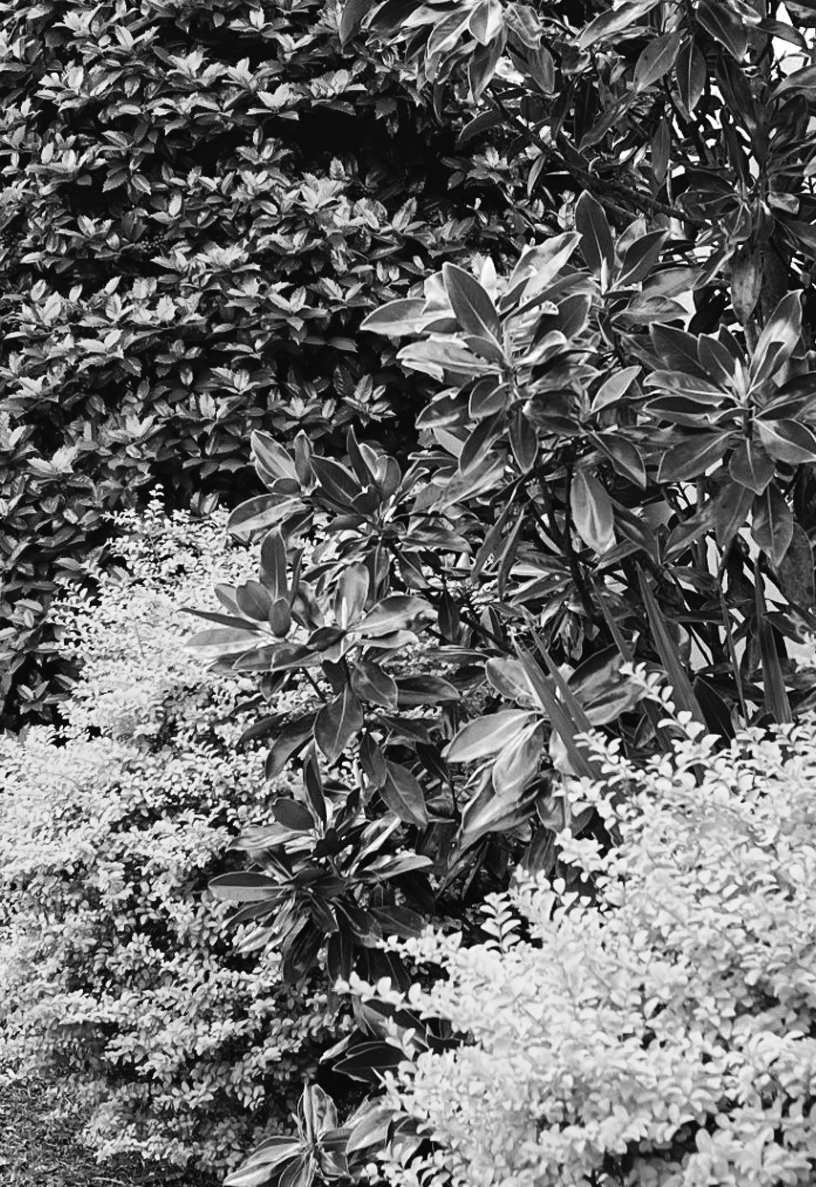
Fill in unwanted gaps with shrubs that contrast in size, shape, texture, leaf or seasonal flowers. Use red, golden, or variegated foliage to interrupt walls of solid green; add a conifer or ornamental grass to broadleaf shrubs. Prune some tightly, leave others a bit more relaxed. Use lacy, layered nandina, winter-blooming mahonia, or summer oak leaf hydrangea to add interest to a row of azaleas, or a Little Gem magnolia when a Leyland cypress browns out.
Not confident in mixing up shrubs, lest neighbors wonder about your ability to fit in with their style? Try a hard feature; even a simple birdbath, urn, or sculpture, or a large pot full of seasonal annuals. They can all be charming ways to break up a boring wall of sameness.
In the garden, diversity isn’t a dirty word; it’s a simple visual way to help a garden look more interesting, year in and year out. And it also helps thwart Felder’s Maxim of the Third.